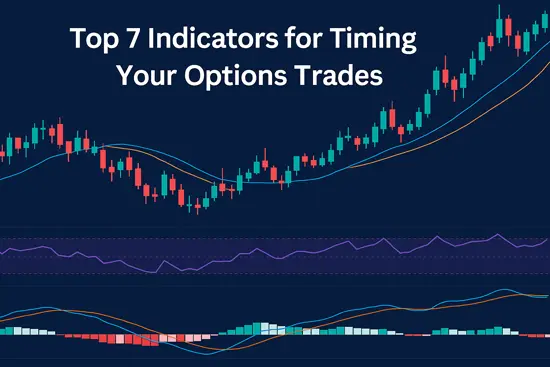
Using technical indicators can help you pinpoint high-probability entries and exits. Here are seven essential tools—and if you’re looking for expert-curated alerts that apply these indicators in real-time, check out our Best Options Alert Service Review 2025.
1. Relative Strength Index (RSI)
RSI measures momentum on a 0–100 scale. Values above 70 indicate overbought conditions; below 30 indicate oversold.
- Application: Look for RSI divergence—if the stock makes a new low but RSI fails to, a bullish reversal may be imminent. For calls, consider entering when RSI crosses above 30.
2. Moving Average Convergence Divergence (MACD)
MACD uses the difference between two exponential moving averages (EMAs), typically 12‐ and 26‐period. The MACD line crossing above its signal line signals bullish momentum.
- Application: For call options, enter when MACD line crosses above its signal after both are below zero (indicating momentum is shifting from bearish to bullish).
3. Bollinger Bands
Bollinger Bands plot a 20‐period moving average with upper and lower bands set two standard deviations away. Prices touching the lower band can signal a potential bounce.
- Application: If a stock’s price “rides” the lower band and RSI is oversold, consider an OTM call. Conversely, price touching the upper band with overbought RSI might suggest put entry.
4. Volume & Volume Oscillator
Volume confirms price moves. Volume oscillators compare short‐term and long‐term moving averages of volume, signaling increasing or decreasing interest.
- Application: A breakout above resistance on high volume (e.g., > 20% above average) is a strong bullish signal. Pair that with a bullish MACD crossover for an entry.
5. Stochastic Oscillator
This measures momentum by comparing a security’s closing price to its price range over a period (commonly 14 periods). %K and %D lines above 80 indicate overbought; below 20 indicate oversold.
- Application: If stochastic is below 20 and then crosses above its signal line, it may indicate a bullish reversal—potential entry for calls.
6. Moving Averages (Simple & Exponential)
- 50‐ and 200‐Day MA: The “golden cross” (50‐day MA crossing above 200‐day MA) is a long-term bullish signal.
- 20‐Day EMA: Shorter EMA for quick momentum.
- Application: For swing or short-term options (2–4 weeks), watch for price bouncing off the 20-day EMA with volume confirmation. For longer expirations, confirm the 50/200 cross first.
7. Average True Range (ATR)
ATR measures volatility. Higher ATR means larger price swings; useful for setting stop‐loss levels.
- Application: If trading weekly options, ensure ATR is at least 1–2% of stock’s price to allow enough movement. Use ATR×1.5 as a trailing stop distance to let the trade breathe without getting stopped out prematurely.
By combining these indicators—RSI, MACD, Bollinger Bands, volume, stochastic, moving averages, and ATR—you’ll build a well-rounded strategy for timing options trades. Always confirm signals across multiple indicators to reduce false positives.